
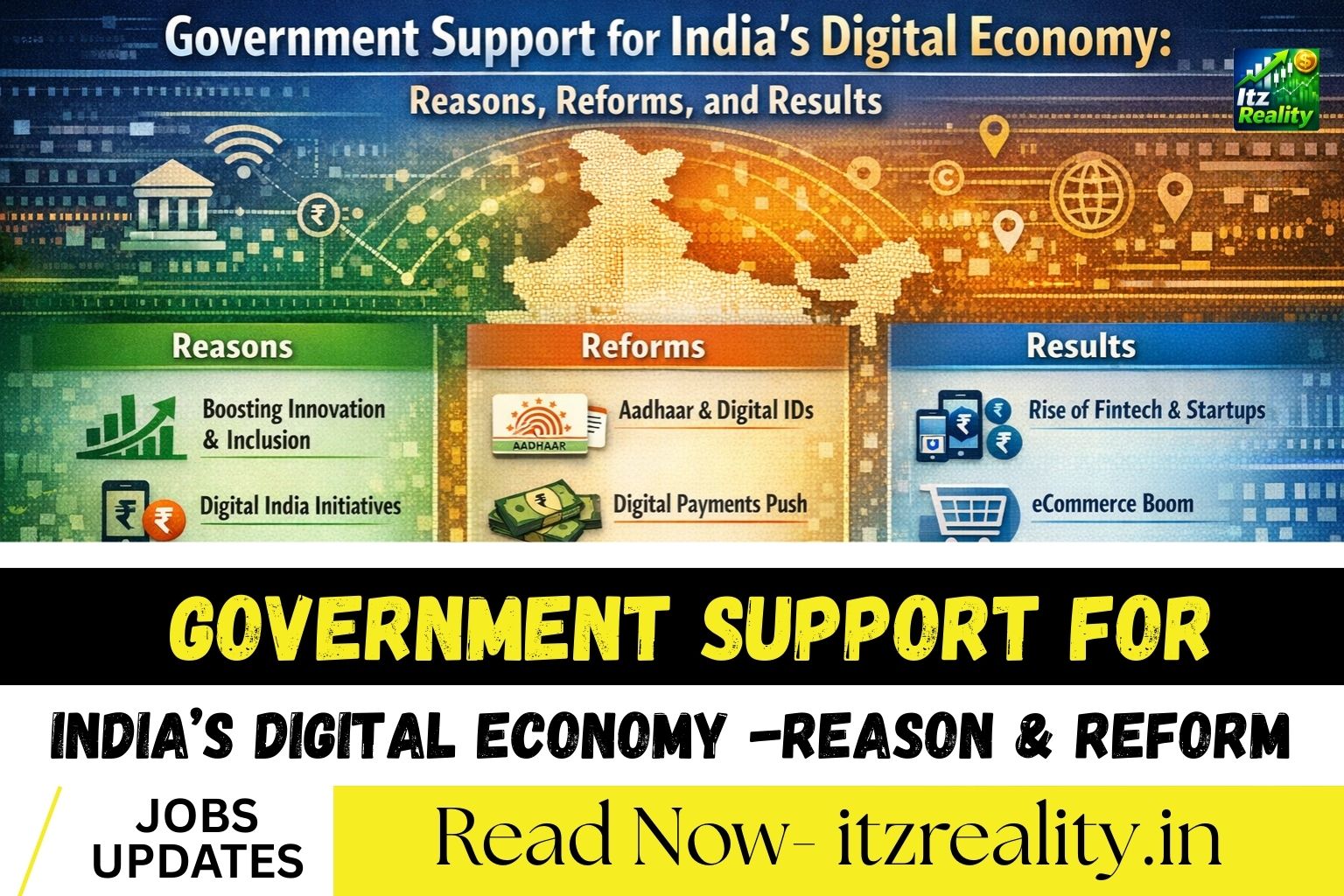
India Digital Economy: The digital transformation has changed the business model across all industries, such as Banking and Finance (BFSI), Healthcare, Manufacturing, Logistics & Supply Chain, and has also hoped to extend their services to the unserved and underserved masses with the introduction of websites, phone banking services, and ATMs. Hence Government wants to implement the same to help people’s to find an easy way to complete their own work.
The digital revolution for India Digital Economy
The Digital Revolution for India was a very necessary factor for the overall growth of the developing economy, as many of the people are dependent on the traditional practices of the banking sector, such as publishing of check book with the offline branch, and doing personal transactions via the branch. Digital Channel helped banks to improve the overall sector by channelizing the online payment system.
● Support from the Government to improve the banking sector problems related issues
● Cheaper, uninterrupted mobile and data services
● Apps that connect businesses with banking
Read More: Gold Silver ETF Price Fall: Here is the quick reason for the same
In 2016, the Govt of India passes AADHAAR Act that requires Indian individuals to provide demographic and biometric details to UIDAI. Pursuant to the order passed by the Supreme Court of India in 2018. The entities using AADHAAR data for KYC cannot use AADHAAR number-related biometric data for the verification of individuals.
Then, the National Payment Corporation of India (NPCI) launched an AADHAAR-based payment mechanism where the government. uses this for Direct Benefit Transfer for various schemes such as employment guarantee, subsidies, and compensation in case of natural calamities. The government helped Citizens while opening ‘Jan Dhan’ bank accounts for a section of the population. As a result, many unserved and underserved account holders started using the mobile apps for managing their businesses.
for India’s Digital Economy, Presence Less Verification (eKYC)
In 2012, the Know Your Customer (KYC) was converted into an electronic form based on the API of eKYC, which uses digitally generated biometrics or an OTP on the registered mobile number. This was all done because of the process for India Digital Economy. eKYC verification allows AADHAAR number holders to use it for establishing their identity in various applications while still maintaining privacy.
Reserve Bank of India (RBI) has made it mandatory for financial institutions to use e-KYC verification, and the financial institutions, Insurance companies, brokers, and depositories require this process to be completed before opening a customer account.
Digital Signature a very important step towards India’s Digital Economy
The Controller of Certifying Authorities (CCA) introduced the digital signature certificate (DSC) in late 2015 for India Digital Economy. CCA has approved 7 Certifying Authorities (CA) to issue digitally signature certificates to individuals where, the applicant can fill up a simple form on the website of CA that requires few details like AADHAAR number and PAN number as well as an OTP verification, applicant can choose the class of DSC as 3 and the period of validity as 2 years also it requires address of the applicant for sending a USB token.
The Introduction of Digital Document Repository (DIGILOCKER)
DigiLocker website, maintained by the Government of India, as of Feb 2024 where millions of users and stores more than 6.28 billion documents (which is increasing day by day). The documents, such as aadhar card pan card, Voter Id, and Driving Licence, can be accessed from anywhere, anytime through the app, and the documents presented in DigiLocker are considered to be valid for verification, identity use, and educational purposes.
Cashless Digital Payments: A Digital Reformation In India

The Govt of India decided to introduce India Digital Economy with safe, quick, and easy to use payments options that would remain within the banking system for fund transfers, clearing, and settlement of the final payment. In 2016, NPCI launched an API called Unified Payments Interface (UPI), which is being used by mobile payment apps for fund transfers, utility bill payments, purchase good, etc. The digital transaction can be tracked in real time, verified online, and audited from anywhere.
The apps provide a rich user experience that leverages transaction history, where Customers using smartphones need to just initiate a transaction by scanning a QR code or paying through UPI id or Mobile Number and settle it by transferring funds from their bank account.
Fintech companies have been successful in disrupting the payment process in India, leveraging UPI to create a payment mechanism that customers have accepted as part of their daily routine.
The following are some regulations applicable to these companies:
● Payment and Settlement Act 2007
● Guidelines for Licensing of Payments Banks, 2014, and Operating Guidelines for Payments Banks, 2016
● RBI Master Direction on Credit Card and Debit Card- Issuance and Conduct, 2022
● Circular on Tokenization- Card transactions, 2019










2 thoughts on “Government Support for India Digital Economy: Reasons, Reforms, and Results”